Humanity
is the start of the race; I say
Humanity is the mould to break away from, the crust to
break through, the coal to break into fire,
The atom to be split.
― Robinson Jeffers
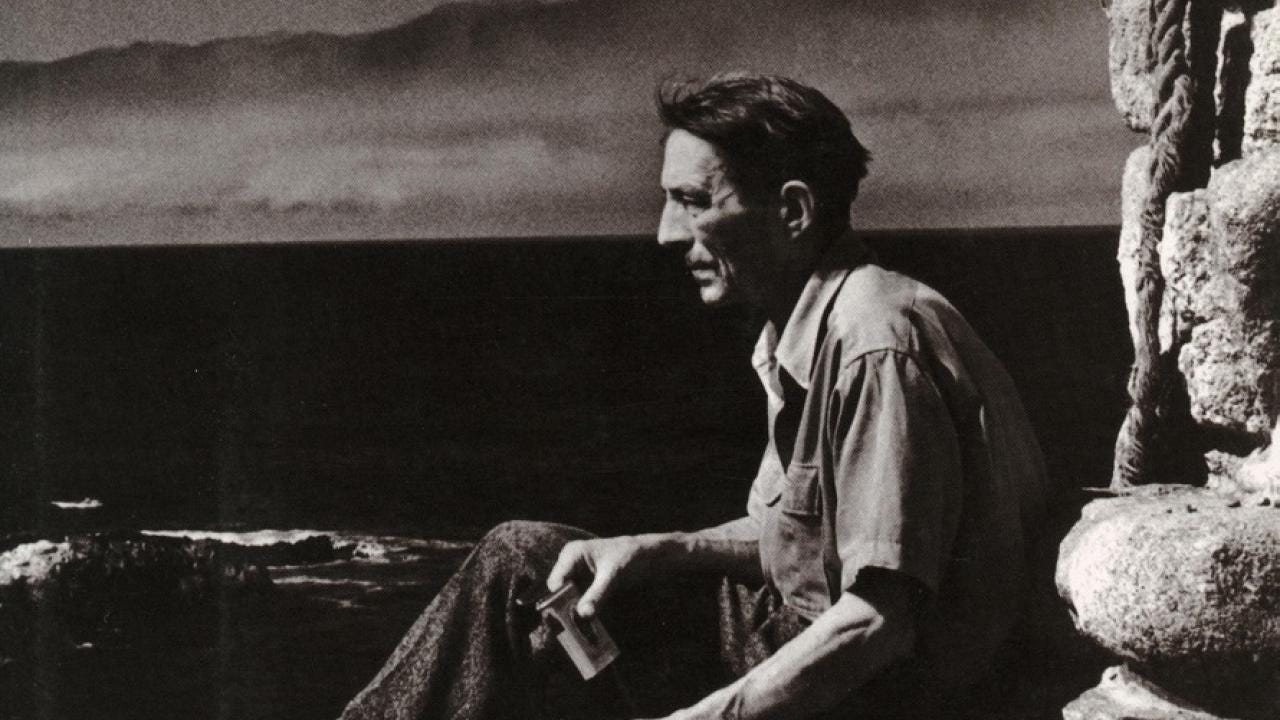
Robinson Jeffers (1887–1962) was a poet of the wild, a seer who stood at the edge of the Pacific, watching the waves carve eternity into stone. He was an impassioned lover of nature and a prophet of its endurance.
Those who read the poetry of Jeffers hear an uncommon voice.
He was one of those rare poetic saints who sought to awaken humanity from its fevered dream of dominion. He believed we were not meant to dominate the natural world, but to live in harmony with it. His poetry was an attempt to open the eyes of the soul, to awaken the overcivilized from their urban slumber, and to think in greater terms of “geological and astronomical time.”
Someone who knew him well described him as a “person of great emotional depth” who “suffered as only a seer can suffer in an age of vulgarity and material affluence.” His philosophy of life was closely aligned with that of Thoreau. Both were passionate spokesmen for the wilderness, advocates for the natural order, disciples of the untamed earth.
He once wrote: “As for me, I would rather be a worm in a wild apple than a son of man. But we are what we are, and we might remember not to hate any person, for all are vicious; And not to be astonished at any evil, all are deserved; And not to fear death; it is the only way to be cleansed.”
Like his contemporary D.H. Lawrence, Jeffers feared that humanity had walled itself in and was utterly lost in the narrow corridors of its own mind, severed from the great, breathing unity of existence.
We had forgotten that we are not the center but merely a ripple in the vast sea of life. In our blindness, we had turned away from the “astonishing beauty of things,” from the quiet perfection of wind over stone, of sunlight glistening on the curve of a wave, of the eternal patience of trees.
This beauty, to him, was not meant to be owned or subdued.
It was a gift, both our birthright and our solemn duty. To see it, to cherish it, to live within it rather than against it. This, he believed, was our inheritance and the only true nobility left to us.
“We must uncenter our minds from ourselves,” he tells us, “We must unhumanize our views a little, and become confident as the rock and ocean that we were made from.”
In his poetry, Jeffers called upon us to step aside, to loosen our grip, to relinquish the illusion that we are the center of creation. He asked us to see—not with the eyes of conquest, but with the humility of those who belong to something vast and ancient.
When folks called him an idealist, a romantic lost in futile reverie, he offered them a harsher truth: we are not eternal, nor are we necessary. One day, the human tide will recede, leaving behind only the cold, indifferent earth.
"Nature knows that people are a tide that swells and in time will ebb, and all their works dissolve ... As for us: We must uncenter our minds from ourselves. We must unhumanize our views a little and become confident as the rock and ocean that we are made from."
Reading Jeffers, you find solace in the thought that, long after we are gone, the rocks will remain, the sun will rise, the winds will still whisper through the trees, and the beasts and insects will continue with their ancient, unbroken effort.
Mother Nature, unbothered and undefeated, will endure.
Below, I share a piece of Jeffers’ prose that I think captures who he was and what he believed. I hope you enjoy it.
Man is part of nature, but a nearly infinitesimal part; the human race will cease after a while and leave no trace, but the great splendors of nature will go on.
Meanwhile most of our time and energy are necessarily spent on human affairs; that can’t be prevented, though I think it should be minimized; but for philosophy, which can be a sort of worship, I would suggest that the immense beauty of the earth and the outer universe, the divine “nature of things,” is a more rewarding object.
Certainly it is more ennobling. It is a source of strength; the other of distraction.
***
I believe that the universe is one being, all its part are different expressions of the same energy, and they are all in communication with each other, influencing each other, therefore parts of one organic whole… The parts change and pass, or die, people and races and rocks and stars, none of them seems to me important in itself, but only the whole.
This whole is in all its parts so beautiful, and is felt by me to be so intensely in earnest, that I am compelled to love it, and to think of it as divine. It seems to me that this whole alone is worthy of the deeper sort of love; and that here is peace, freedom, I might say a kind of salvation, in turning one’s affections outward toward this one God, rather than inward on one’s self.


Thank you for this introduction (I'm a newbie to poetry). This, even this small selection of his words and sentiments, is a salve. Human endeavors, all the little tasks we attend to, are but distractions from our experience of living in the natural world.
"Rearmament," the startling poem that starts this piece, is one Jeffers wrote when he saw WWII coming. A time with parallels to our own.
https://medium.com/@keithpp/rearmament-b73447c12756